
No products in the cart.

How Long Does It Take to See Results from a Hair Growth Kit?
You’ve started your hair growth kit, you’re using it consistently, and you’re checking the mirror every morning hoping for a difference. If this sounds familiar, you’re not alone – one of the most common questions people ask after starting a routine is simple: what’s the actual hair growth kit results timeline, and when is it fair to expect a visible change?
The honest answer is that hair growth kits work with your hair’s natural growth cycle, not against it; which means results build in stages rather than appearing overnight. Understanding that timeline can be the difference between giving a routine a fair chance and quitting right before it starts working.
Why Hair Growth Takes Time in the First Place
Before getting into the hair growth timeline for any kit, it helps to understand what’s actually happening beneath the surface. Hair grows in cycles, not continuously and uniformly across your scalp:
- Anagen (growth phase): The active phase where hair follicles produce new hair. This phase can last anywhere from 2 to 6 years, depending on genetics.
- Catagen (transition phase): A short transitional stage lasting a few weeks, where hair growth slows and the follicle shrinks.
- Telogen (resting phase): The resting phase before the hair eventually sheds and the cycle restarts, typically lasting a few months.
At any given time, different hairs on your scalp are in different phases. This is exactly why hair growth products/kits included – can’t “switch on” visible results immediately. You’re not just growing new hair; you’re waiting for enough follicles to move through their natural cycle before the improvement becomes visible to the eye.
Hair Growth Kit Results Timeline: What to Realistically Expect

So, what does the hair growth kit results timeline actually look like when you’re using a shampoo, serum, and supplement together as a system? While individual results vary based on hair type, the underlying cause of thinning, and consistency of use, a general staged pattern is worth knowing:
Weeks 1–4: Foundation stage
This is where the kit is doing quiet, unglamorous work – improving scalp condition, reducing buildup, and creating a healthier environment for hair to grow. Visible change is usually minimal at this point, and that’s expected, not a sign of failure.
Weeks 4–12: Early signs
Many people begin noticing reduced shedding first, before they notice growth. Strands may feel slightly stronger, and hair fall during washing or brushing may start to ease. This stage is often where people either stay consistent or give up too early; right before the more visible changes begin.
Months 3–6: Visible improvement
This is typically when new, finer hairs (often called “baby hairs”) become noticeable along the hairline or part, and overall density can start to look fuller. This aligns with the natural hair growth cycle; most hair follicles need at least one full cycle phase to show meaningful, visible change.
Months 6+: Sustained results
With continued, consistent use, improvements in thickness and density tend to become more stable and noticeable to people around you, not just yourself in the mirror.
It’s worth being direct here: these timeframes are general expectations based on how hair biology works, not a guarantee; individual results depend on the root cause of your hair fall, your hair type, hormonal factors, and how consistently the kit is used.
Setting Realistic Hair Regrowth Expectations

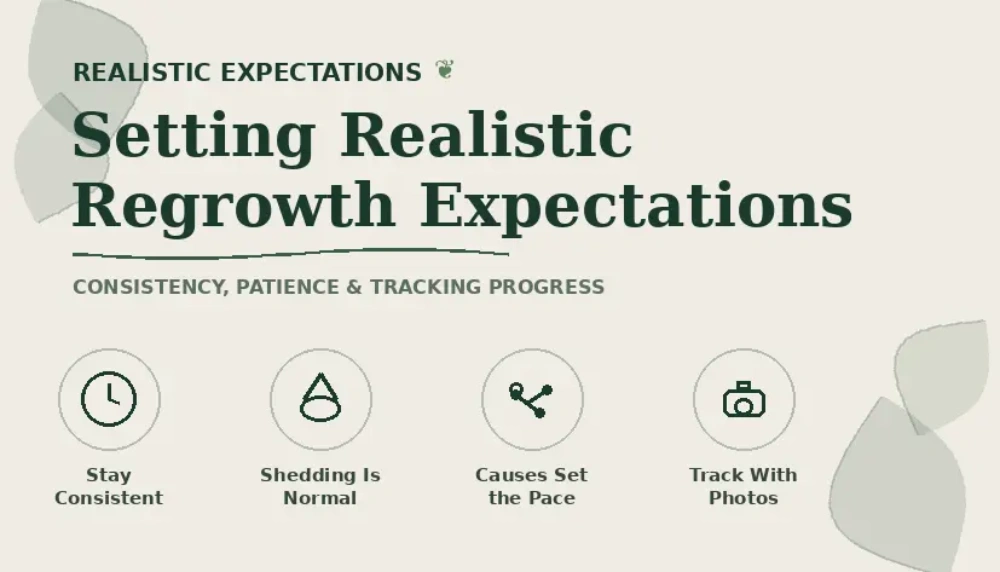
Realistic hair regrowth expectations matter because unrealistic ones are one of the biggest reasons people abandon a good routine too soon. A few things worth keeping in mind:
- Consistency matters more than intensity. Using a kit sporadically – skipping days or weeks – resets the benefit clock more than most people realize. Hair follicles respond to sustained input, not occasional bursts of effort.
- Shedding before growth is normal, not a red flag. Some people notice slightly increased shedding in the first few weeks as weaker hairs in the resting phase are naturally released to make room for new growth.
- Underlying causes change the timeline. Hair thinning linked to stress, postpartum changes, or nutritional gaps often responds faster to a consistent routine than thinning influenced by genetics or hormonal conditions, which may take longer or need additional support.
- Photos beat memory. Because change happens gradually, it’s easy to miss progress in the mirror day to day. Taking a photo of your hairline or part every 2–4 weeks, in the same lighting, is a far more reliable way to track real change than relying on how your hair “feels.”
How Long Does Hair Serum Take to Work Within a Kit?
If your kit includes a leave-in growth serum alongside shampoo and supplements, it’s natural to wonder how long does hair serum take to work on its own. Serums are typically formulated to be applied directly to the scalp for more concentrated, targeted delivery, and most people report early signs; like reduced shedding, within 4 to 8 weeks of consistent daily or alternate-day use. However, a serum works best as part of the full kit rather than in isolation, since shampoo, serum, and supplements are usually designed to support different parts of the same process: cleansing and prepping the scalp, delivering active ingredients, and supporting hair health from within.
How to Know If Your Kit Is Actually Working
Since progress is gradual, it helps to know what “working” looks like before you expect dramatic before-and-after results:
- Reduced hair fall during washing, combing, or on your pillow
- Shorter, finer regrowth becoming visible along the hairline or part
- Hair feeling less brittle or prone to breakage
- A generally healthier-looking scalp with less flaking or irritation
If you’re seeing none of these signs after 4-6 months of consistent use, it may be worth reassessing whether the underlying cause of your hair loss needs a different approach – a dermatologist consultation can help identify whether something beyond topical care is contributing to your hair fall.
FAQs
What is a realistic hair growth kit results timeline?
Most people notice reduced shedding within 4–12 weeks, early regrowth around the 3–6 month mark, and more stable, visible density improvements after 6 months of consistent use.
How long does hair serum take to work?
Early signs like reduced shedding are commonly reported within 4–8 weeks, though visible density changes typically take longer and are best supported by using the serum as part of a complete routine.
Why haven't I seen results yet after a month?
One month falls within the foundation stage of the hair growth cycle; visible change usually isn't expected this early, even with consistent use.
Does shedding at the start of a hair growth kit mean it's not working?
Not necessarily. Some mild, temporary shedding as weaker hairs move out of their resting phase can be a normal part of the process, not a sign of failure.
How can I track my hair growth timeline accurately?
Take consistent photos of your hairline or part every 2–4 weeks in the same lighting, this is far more reliable than relying on daily visual memory.
Conclusion
There’s no shortcut around how hair biology works, a real hair growth kit results timeline unfolds in stages, not overnight, and understanding that timeline is what separates people who stick with a routine long enough to see results from people who quit right before the visible changes begin.
If you’re ready to commit to a consistent routine backed by a system designed to work together -cleansing, targeted serum, and nutritional support, PRISDERMA’s Hair Growth Kit is built around exactly this staged approach to hair health, rather than a single quick-fix product.
Curious what your hair growth journey could look like? Explore PRISDERMA Hair Growth Kit for men and women, and start tracking your own timeline from week one.
Leave a Reply